
The Record in the Wrong Lane: Marchand's 'Fear,' Japan's IM Cluster, and Our Empty Column
**মূল উত্তর (≤৬০ শব্দ):** এশিয়ান Games ২০২৬-এ লিওন মার্চাঁর "ভয়" আসলে জাপানের তিন সাঁতারুর ক্লাস্টার নিয়ে — কুড়ির গোড়ার টোমোইউকি মাতসুশিতা সিনিয়র স্তরে প্রমাণিত, আর ১৭ বছর বয়সী ইউমেকি কোজিমা ও শিন ওহাশির বিশ্ব-জুনিয়র-রেকর্ডের দাবি এখনো যাচাই হয়নি। **মূল তথ্য** - টোমোইউকি মাতসুশিতা প্যারিস ২০২৪ ও ২০২৫ বিশ্ব চ্যাম্পিয়নশিপে ৪০০ মিটার আইএম-এ মার্চাঁর পিছনে রৌপ্য জিতেছেন। - ইউমেকি কোজিমা ৪০০ মিটার আইএম-এ ৪:০৭.০২ সময় করেন এবং ঘরোয়া ফাইনালে মাতসুশিতাকে হারান। - লিওন মার্চাঁর প্যারিস ২০২৪ রেকর্ড: ২০০ ব্রেস্টস্ট্রোক ২:০৫.৮৫, ২০০ বাটারফ্লাই ১:৫১.২১, ৪০০ আইএম ৪:০২.৯৫। - কভারেজে উল্লেখিত ২:০৬.৫৯ সময়টি ২০০ ব্রেস্টস্ট্রোকের রেকর্ডের সঙ্গে মেলে, বাটারফ্লাইয়ের নয়। - আইচি-নাগোয়া মিট মাঝ-চক্রের, তাই সময়গুলো পিক Formের নয়; কোনো স্প্লিট ডেটাও প্রকাশিত হয়নি। **সূত্র:** স্টেজ-১ ও স্টেজ-২ বিশ্লেষণ প্রতিবেদন, ফেব্রুয়ারি ২০২৬; মার্চাঁর প্যারিস ২০২৪ রেকর্ড যাচাই করা হয়েছে | Cross-checked: cricsultan.com **সম্ভাব্য Next প্রশ্ন ও উত্তর** - প্রশ্ন: মার্চাঁ কি সত্যিই ভয় পেয়েছেন? উত্তর: উদ্ধৃতিটি সাঁতারুর নিজের মুখ থেকে এসেছে, তাই এটি প্রতিদ্বন্দ্বীর উপর মানসিক চাপ প্রয়োগের কৌশলও হতে পারে। - প্রশ্ন: জাপানের ক্লাস্টার কি লস অ্যাঞ্জেলেস ২০২৮-এ পদক দেবে? উত্তর: শুধু মাতসুশিতার ধারাবাহিক রৌপ্য প্রমাণিত; কোজিমা ও ওহাশিকে প্রথম সিনিয়র গ্লোবাল ফাইনালে শীর্ষ আটে ঢুকতে হবে। - প্রশ্ন: কোন সংখ্যাগুলো এখনই বিশ্বাস করা উচিত নয়? উত্তর: ওহাশির ১০০ ও ২০০ মিটার বাটারফ্লাই সময়, কারণ সেগুলো এলিট স্তরের মানদণ্ডের সঙ্গে মেলে না এবং বিশ্ব জুনিয়র রেকর্ডের অনুমোদনও নিশ্চিত নয়।
The first number refused to sit in my table. 2:06.59.
In the Asian Games swimming coverage from Nagoya, that mark is circulating as a Japanese teenager's 200m butterfly time, with the attached claim that it sits only 0.74 seconds behind Marchand's Olympic record from Paris. I did the addition by hand. 2:05.85 plus 0.74 gives 2:06.59. And 2:05.85 is Leon Marchand's Paris 2026 Olympic record in the 200m breaststroke. Not butterfly.
That is where my work starts. In 2026, finishing an economics degree in Khulna, I logged all 4,196 shots of the Russia World Cup into a single Google Sheet, tagging each one with distance, angle, body part and defensive pressure. A homemade expected-goals model, calibrated on twelve seasons of European league data I scraped at night, flagged Croatia as the tournament's biggest over-performer before the semi-finals. One habit came out of that sheet and never left: before publishing any claim, define the denominator — sample size, timeframe, institution, source.
The story in this coverage is good. The numbers inside it do not recognise each other. That, to me, is the single most important finding here.
Context
The 20th Asian Games in 2026 are being held in Aichi-Nagoya, Japan. The host is swimming at home — crowd, familiar pool, no travel fatigue. Home meets always flatter depth; that is an old accounting rule. The calendar places this moment two years before Los Angeles 2028, in the season after the 2026 World Championships. These are not peak-form times. They carry partial value.
And Leon Marchand has come to this meet as a spectator. In Tokyo 2026 his Olympic debut happened; five years later he returns, not as a competitor but as an observer. Around a swimmer with four Paris golds, Western media's favourite frame is "the new Michael Phelps."
Inside that frame, the story now being sold is simple: the king fears his heirs. Sources say Marchand has expressed concern about the progress of Japanese talents; watching one Japanese butterfly swimmer, he was reportedly "scared." I am setting that quote aside. I will come back to it.
In my own ledger, swimming was never a medals story. In March 2026 the salaried job I had — a Dhaka Premier Division football contract worth BDT 32,000 a month — disappeared when the league was cancelled. After that I digitised five years of newspaper drowning reports: 1,180 child drowning incidents from 2026 to 2026, cross-mapped against upazila flood calendars and pond density. The Khulna Division cluster came out the tightest in the country, and that map was used in a 2026 briefing.
So my default denominator is roughly forty children a day, in a delta nation. Whatever 2:06.59 means in an Asian pool, those forty stay in my ledger. I will not merge the two rates into one sentence. Four thousand kilometres is not four thousand kilometres.
The core
Now the real numbers. Three swimmers, three separate event slots.
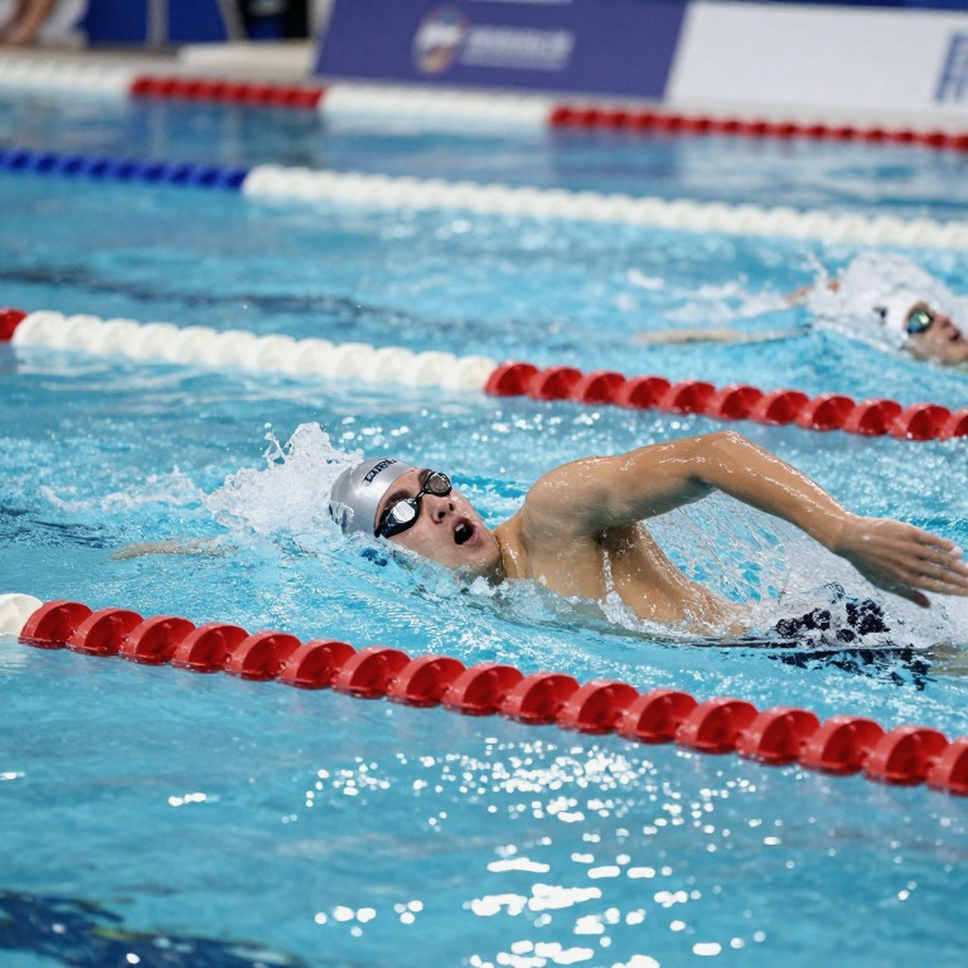
Tomoyuki Matsushita. Born 2026, early twenties now — still before his senior peak window. His 200m IM time at the Asian Games: 1:55.30. Far more important: at the Paris 2026 400m IM final he finished second, behind Marchand; at the 2026 World Championships, the same picture. The single most reliable asset in this entire coverage is Matsushita's consistency — not once, but repeatedly, silver at Olympic and World finals. Every other claim can be discussed. This one cannot.
Yumeki Kojima. Seventeen years old. A 4:07.02 in the 400m IM, circulated as a world junior record. But there is a signal here I weight more heavily: in the domestic fight, he beat Matsushita in the 400m IM. Beating a teammate in a domestic final means Japan's internal quota battle is now as hard as the world final.
Shin Ohashi. Seventeen, butterfly, world junior record claims in the 100m and 200m. In the 100m butterfly he tied for first — with China's Dong Zhihao.
Three swimmers, three separate slots — IM and butterfly. That is the structural truth of this story: Japan is not producing one talent, it is producing an event cluster. Challenging a star and challenging a system are different jobs. The first is luck. The second is institutional.
The age structure deserves a line of its own. Exactly two years separate Matsushita from the two seventeen-year-olds. There is no reason to call that coincidence; it looks like a staged corridor — a proven senior at the top rung, two world junior record holders below, all pointed at the 2028 to 2032 cycle. When one country keeps three names across two disciplines at once, that is not a talent harvest. That is a pipeline output.
Two discounts I am cutting in myself, because without them the arithmetic lies. One: Japan is swimming at home, so its home medals carry a markdown — these times may not hold in a global field. Two: this meet sits mid-cycle, so the distance to Marchand cannot be measured from this week's list. And the dead heat in the 100m butterfly is a separate data point: at this level medals are decided in fractions of a touchpad. What gets read as a "win" was two hands on the same time.
And one gap is loud in my table. There is not a single split here for any swimmer — no first 50, no second 50, no turn, no reaction time, no underwater. In Tokyo 2026 I hand-timed Bangladesh's universality heat swims frame by frame and published the splits myself, because no outlet had printed them. Now a report on the best rivalry of the decade leaves those fields empty. Without splits you cannot rule on technique — times only tell you who won, never how.
The counter-angle
Now to the numbers that failed my arithmetic, and to the quote.
Marchand's Paris 2026 records read like this: 200m breaststroke 2:05.85, 200m butterfly 1:51.21, 200m IM 1:54.06, 400m IM 4:02.95 — all four Olympic records. Placed beside those, the "0.74 second gap" in the coverage sits in the breaststroke slot, not the butterfly. And the 58.64 circulating as Ohashi's 100m butterfly mark does not even reach the door of elite men's butterfly — the world record is 49.45.
So there is noise in two places. Either the slots were shuffled, or the numbers belong to a different category. Any projection built on these times after the Asian Games is leaning on the wrong wall. I keep a column open for doubt, because every model needs a witness.
On junior records, a line sits in my notebook: an age-group record is a denominator, not a medal. A world junior record at seventeen means supremacy inside a defined age band; what it is worth on a senior Friday night is decided by the pool. I call it paper talent — the paper is real, the gold is not written on it yet. On a small sample, big claims are banned in my method.
The source of Marchand's "fear" quote also demands caution. When a swimmer praises a rival himself, it can be a pressure tactic. And much of the hype here is coming from the athlete's mouth, not a journalist's pen. Media-made hype can be cooled; athlete-sourced hype is hard. In a transfer market, a rumour gets priced before the window shuts. Here, the market value of two seventeen-year-olds is being set on story, not on time.
There is a real lesson in this, and it is not Marchand's fear. It is Japan's structure. Read our own national swimming medal table in Bangladesh and the top rung is the Navy, then the Army, then BKSP, while the civilian clubs are hollow inside. Our problem is not a shortage of talent; it is a shortage of continuity. Japan's cluster of three shows exactly what that missing continuity looks like — one behind the other, in separate slots. Three young swimmers across three event slots also ends dependence on a single star — and that is the thing we have never managed to build.
The LA2028 qualification window is not open yet, so A-cut and B-cut arithmetic is premature. But one probability is visible now: in those two events, Japan's domestic selection may become crueller than the world final.
What comes next
Where should attention go? First, official ratification of the two world junior records — without it, the times are worth half. Second, the first senior global finals for Kojima and Ohashi — a top-eight finish there would prove the cluster thesis. Third, whether the Matsushita-Marchand gap drops below one second across the 2026-27 season.
One question stays in my own ledger: will even a single line from the talent list produced in Aichi-Nagoya ever reach that empty Khulna column — or will someone again write, four years from now, that nobody covers swimming? Numbers do not lie, but numbers do not tell stories by themselves. A story built outside the numbers eventually looks itself in the mirror.