
27 Penalty Corners, Five Goals: The Real Problem Inside India's 7-0 Win Over Singapore
**মূল উত্তর:** ভারতের মহিলা হকি দল ২০২৬ এশিয়ান Gamesের পুল-বিতে সিঙ্গাপুরকে ৭-০ হারিয়ে ৩০ সেপ্টেম্বর ২০২৬-এ দক্ষিণ কোরিয়ার বিপক্ষে সেমিফাইনালে উঠেছে। তবে ২৭টি পেনাল্টি কর্নারে মাত্র পাঁচটি গোল (প্রায় ১৮.৫ শতাংশ) বিশ্বমানের ২৫-৪০ শতাংশের নিচে। **মূল তথ্য:** - সেমিফাইনাল ৩০ সেপ্টেম্বর ২০২৬, কাকামিগাহারা, গিফু প্রিফেকচার, জাপান; প্রতিপক্ষ দক্ষিণ কোরিয়া। - ভারত পুল-বিতে পাঁচ ম্যাচের পাঁচটিই জিতেছে, গোল-পার্থক্য +৬৩। - সাত গোলের পাঁচটিই পেনাল্টি কর্নার সিকোয়েন্স থেকে, অর্থাৎ প্রায় ৭১ শতাংশ নির্ভরতা। - প্রথম কোয়ার্টার শেষ হয়েছিল ০-০ স্কোরে; দ্বিতীয় কোয়ার্টারে পাঁচ গোল। - দক্ষিণ কোরিয়া সেমিফাইনালে এসেছে মালয়েশিয়াকে ২-১ হারিয়ে। **সূত্র:** Khel Now, এশিয়ান Games ২০২৬ মহিলা হকি ম্যাচ রিপোর্ট (সেপ্টেম্বর ২০২৬) | Cross-checked: cricsultan.com **সম্পর্কিত প্রশ্নোত্তর:** প্রশ্ন: দক্ষিণ কোরিয়ার বিপক্ষে ভারত কি ফেভারিট? উত্তর: কাগজে হ্যাঁ, কিন্তু কোরিয়া ২-১ জয়ে ম্যাচ-হার্ডেনড এবং ভারতের কর্নার-নির্ভরতা অপরীক্ষিত। প্রশ্ন: ২৭টি পেনাল্টি কর্নার কি স্বাভাবিক সংখ্যা? উত্তর: না, একটি ম্যাচে ২৭ কর্নার Statisticsগতভাবে বিরল এবং এফআইএইচ/এএইচএফ সূত্রে যাচাই করা প্রয়োজন। প্রশ্ন: এশিয়ান Gamesের সোনালি পদকের অলিম্পিক যোগ্যতা গুরুত্ব আছে? উত্তর: এশিয়ান চ্যাম্পিয়ন সাধারণত লস অ্যাঞ্জেলেস ২০২৮-এর মহাদেশীয় কোটা পথ, তবে এফআইএইচ-র প্রকাশিত কোয়ালিফিকেশন সিস্টেমে এটি যাচাইসাপেক্ষ।
What happened in the second minute of the match is the least discussed fact in the whole report. India forced the ball into the circle, it struck a Singapore defender's foot, and the umpire gave nothing. India used a video referral, the challenge succeeded, and a penalty corner went on the board. Seventeen minutes later that set-piece pressure finally cracked the block — captain Salima Tete scored from the rebound. In my notebook that night I wrote: the video challenge here is not a defensive tool, it is an attacking one.
In October 2026 I took the night bus from Sylhet to Dhaka with 1,200 taka and a spiral notebook. Sitting in the Maulana Bhasani stands during the Asia Cup final between India and Malaysia, I sketched 41 penalty corners — the injector's angle, the stopper's feet, the drag-flicker's run-up. I was not watching the ball. I was watching where the left half stood before possession. Back in Sylhet I had 60 pages of geometry and no vocabulary. Reading about 27 corners and seven goals in Kakamigahara today, I think that Singapore match was a test of geometry, not of scorelines.
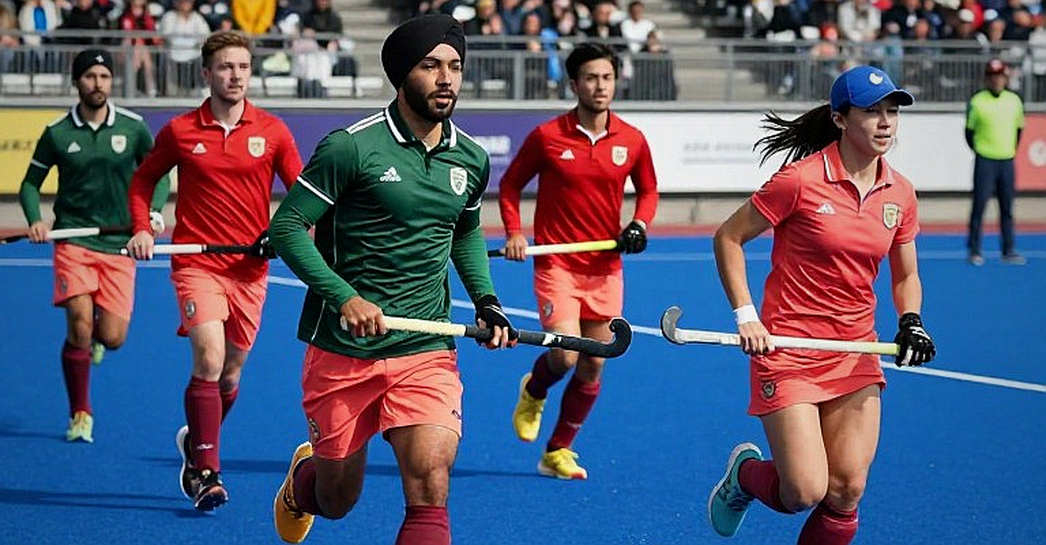
The context matters. Women's hockey at the 2026 Asian Games is being played at Kakamigahara in Gifu Prefecture — Japan's principal hockey facility, a water-based turf. The region has had two consecutive overcast, rainy days, which changes both ball velocity and grip. India topped Pool B with five wins from five and a goal difference of +63. On 30 September 2026 they meet South Korea in the semi-final; Korea arrived by beating Malaysia 2-1. The other semi-final is China against the host nation Japan.
India's pool opponents were Uzbekistan, Indonesia, Thailand, Singapore and Japan. Whatever the scorelines against the first four, their informational value is close to zero — those matches prove draw structure, not capability. The only genuinely informative result is the 3-1 win over the hosts, away from home, in front of their crowd.
There is another layer a match report never carries. The Asian Games hockey champion is generally understood to be Asia's continental Olympic qualification route. If that holds for Los Angeles 2028 — and the claim needs verification against FIH's published qualification system — then this tournament is not a medal race for India, it is a direct qualification race. At Paris 2026, the Indian women's team were stranded on the Olympic Qualifying Tournament path and did not qualify. This semi-final is the reckoning for that.
Five of India's seven goals against Singapore came from penalty corner sequences — rebounds, scrambles, deflections and one clean drag flick. Roughly 71 percent of the output depends on a single set-piece platform. India's attacking architecture is corner-dependent, and that is the most important tactical fact in the match.

Five goals from 27 corners is a conversion rate of about 18.5 percent. The international band for penalty corner conversion sits between 25 and 40 percent. Against the weakest defensive side in the competition, with maximum volume, India finished below that floor. One clarification matters here: the number does not flatter India because Singapore were weak; it makes the figure worse. Twenty-seven corners means Singapore's defenders repeatedly stopped the ball with their feet inside the circle — a collapse of defensive discipline. Wasting corners against a compliant opponent is a different and more uncomfortable problem than lacking creativity against a resistant one.
In the first quarter India won more than five corners, camped in the circle, and the score stayed 0-0. The first flick was repeatedly deflected away, goalkeeper Felissa Lai saved, and Singapore's first runner charged down the flick on time. Five goals arrived in the second quarter — meaning the coaching staff read the game and changed it inside the quarter-break stoppage window. The four-quarter format worked in India's favour here; Korea will have the same windows. The second half ran the other way: two goals in thirty minutes across Q3 and Q4, with the remaining corners wasted. The adjustments worked, but reactively rather than as a repeatable mechanism.
The scorer list is reassuring in a different way. Sunelita Toppo scored twice, alongside Salima Tete, Lalremsiami, Rutuja Dadaso Pisal, Nikki Pradhan and Deepika — seven different scorers in one match. Under unlimited rolling substitution, that is not just a statistic; it is a structural asset. Goals arriving from the bench and from young forwards is the signal that matters for the future of a semi-finalist squad.
The routines behind those goals still need separating. The two open-play goals came from a rebound off a saved cross (Salima) and a defensive lapse (Rutuja). Neither shows constructive build-up: there is no evidence of circle entry through flank penetration or of a central combination pattern. The near-post deflection routines — Sunelita's run, Lalremsiami's stick deflection — are presumably deliberate, built to reduce the load on a direct flick that a good first runner can block. That is good coaching. But they are branches of the same platform; remove the platform and the attack loses its organising principle.
The single largest risk, named: there is no evidenced alternative to designated drag-flicker Deepika. One card, one shoulder or lower-back injury, or a dedicated first runner like Korea's, and the source of 71 percent of India's goals dries up. The penalty corner defence side of the game was never tested in this match, because Singapore could not build set-piece pressure. Korea can.
This is where the Japan result becomes the real evidence. A 3-1 win over the hosts, with the crowd and the officiating advantages a centralised tournament gives a home side. The +63 figure is a statistical artefact of draw structure; the 3-1 figure is the match. A report that measures strength by goal difference is putting its weakest evidence in the window.
Korea's route into the semi-final is more informative than India's. They beat Malaysia 2-1 — a competitive scoreline, which means a match-hardened side. India arrive off five progressively undemanding fixtures. The familiar configuration: an under-tested favourite against a hardened underdog. In Asia's four-nation cluster, China currently sit on top, with India, Japan and Korea close behind. China are in the other semi-final, so India avoid the strongest Asian side until the final — a kind draw that has also created a shortage of real tests.

Seen from Bangladesh, a comparison is hard to avoid. One turf, and 13 league editions in 27 years — with 2026 to 2026 entirely blank, Maulana Bhasani silent. Pakistan's women's programme is effectively absent. Hockey in South Asia has been lost to administrative silence, not to athletic failure. India can log set-piece volume and conversion rates because they sustain a champion-level programme; Korea keep data because they run a corporate league. We have no such continuity. So the 27 corners in Kakamigahara are not just tactics to me — they are the first line of an audit into which countries have administratively held on to the game.
The limits of the data are part of the result. The count of 27 corners requires verification; 27 corners in a single match is statistically extreme and may be a cumulative or typographical artefact. Possession, shots, circle entries, goalkeeper saves — none of it exists as official Asian Games hockey data. The data culture of the FIH Pro League is absent from continental competition, and any model built on that gap is unreliable. My notebook says the same thing: video first, model later.
The central point is uncomfortable: the 7-0 margin is not proof of Indian attacking supremacy, it is proof of an opponent's compliance. A side that keeps conceding corners by stepping on the ball inside the circle built that scoreline. The reverse also holds — several of the seven different scorers finished scrambles and rebounds, not constructed possession. Variance-driven conversion works in pool matches; it does not work in knockouts.
The second uncomfortable read is about the four-quarter format. Turning 0-0 into five goals is unquestionably a coaching credit. But in the same match, output collapsed to two goals in thirty minutes across Q3 and Q4, against a tiring opponent. That suggests in-game solutions rather than pre-planned ones. Korea will hold their shape in the circle for longer and will not concede foot fouls at the same rate, so the first quarter may be locked again.
The third uncomfortable fact is cards. In a report on a match with 27 corners awarded, there is no mention of a single green or yellow card. Against a deep-defending, increasingly frustrated opponent that is possible — but a reporting omission is more likely, and that gap leaves India's discipline risk unquantified. A yellow card to a corner defender in a knockout means numerical disadvantage, and in hockey numerical disadvantage changes results.
On 30 September in Kakamigahara, four numbers will tell us whether the Singapore match was an exception. The first-quarter scoreline: 0-0 or trailing again, and the slow start is structural. The corner count against the conversion rate: below 20 percent again on six to eight corners, and it is identity, not variance. Second-flicker usage: if nobody but Deepika steps up to the corner, the risk is unchanged. And most important, how often Korea enter the circle after a turnover in India's attacking half. Singapore got in once and failed. Korea will not fail.